· 9 min read
What unqualified consultations cost an immigration firm
Agency reports price the click. They do not price the forty-five minutes a partner spends with someone who was never going to qualify.
Every immigration firm running paid acquisition knows its cost per lead. Very few know what a case actually costs them, because the largest line item never appears in the report. It is not media spend. It is the hour a partner spends on a consultation with someone who was never going to qualify.
This post is about where in your funnel unqualified people get removed — what we call the filter point — and why moving it earlier is worth more than any reduction in cost per click. It includes the arithmetic, the audience criteria we actually use for talent-visa work, and the case types where this argument does not hold.
How paid acquisition is normally reported
The standard setup is reasonable on its face. The firm bids on the obvious terms — "EB-1A attorney", "O-1 visa lawyer", "immigration lawyer near me" — and an agency reports back on spend, clicks, cost per click, form fills and cost per lead. Intake calls the form fills. The ones who answer get booked in with an attorney.
Nobody is being dishonest here. Those are real metrics measuring real things, and if the objective were traffic they would be the right ones. The problem is that the report ends at the form fill, and the expensive part of the process starts there.
Three flaws in cost per lead
Flaw 1: it prices the click, not the case
Cost per lead contains exactly one cost: media. Everything downstream — the intake coordinator's time, the scheduling, the no-shows, the consultations themselves — is treated as free because it is already on payroll.
It is not free. It is capacity. An hour a partner spends with an unqualified enquiry is an hour not spent on a petition, a referral relationship, or a consultation with someone who would have signed. In a practice where the partners are the constraint, that hour is the most expensive thing the firm owns, and cost per lead is silent about it.
Flaw 2: search intent is not qualification
Google knows what someone typed. It does not know whether they hold a doctorate, whether they lead a research group, or whether they have eleven years in a field. A principal scientist and a final-year undergraduate typing "EB-1A requirements" are the same person to the auction.
We have written about why that gap matters for talent-visa work and won't repeat the argument here. The relevant consequence for this post is narrower: if the channel cannot see qualification, then qualification has to happen somewhere after you have paid.
Flaw 3: it makes the wrong campaign look like the better one
Two campaigns, same spend. One returns a $90 cost per lead and one qualified consultation a month. The other returns $310 and five. On the report, the first campaign wins by a factor of three. In the practice, the second one is doing all the work.
This is not hypothetical — it is the single most common reason firms cancel a channel that was working. The metric being optimised and the outcome being paid for have come apart, and the report gives no way to notice.
The arithmetic nobody runs
Here is the calculation in full. The numbers below are illustrative — put your own in, they are the ones that matter — but the shape holds across every talent-visa account we have looked at.
Start with a month of broad search advertising:
- 100 clicks at $12 each — $1,200 in media
- 10 enquiries, a 10% landing page conversion rate — $120 cost per lead
- 6 of those book a consultation and show up
- 2 are plausibly qualified for the petition they asked about
- 1 signs
Cost per lead reads $120. Media cost per signed case reads $1,200. Both are true and both are incomplete, because six consultations happened.
At 45 minutes each including preparation and follow-up notes, that is 4.5 hours of attorney time. Value that hour at $500 — conservative for a partner at a practice doing EB-1A work — and it is $2,250.
So the fully loaded cost of that signed case is $3,450, of which $2,250, or roughly 65%, is time that appeared in no report. Four of those six consultations, three hours, and $1,500 of capacity, went to people the firm was never going to be able to help.
Now change one variable. Keep everything else identical, but suppose 4 of the 6 consultations are qualified instead of 2, and 2 sign instead of 1. Media spend has not moved. Attorney hours have not moved. Loaded cost per case halves.
That is the entire argument. The lever is not cost per click. It is the ratio of qualified to unqualified consultations, and almost nobody instruments it.
Across our own talent-visa accounts, around 85% of the consultations that get booked are qualified. We cannot give you the matching number for the same firms' search campaigns, because almost none of them were measuring it before they started. That is not a gap in this post. It is the thing the post is about.
The filter point
Unqualified people get removed from your funnel somewhere. There are only three places it can happen, and they differ by about an order of magnitude in what they cost.
Filter in the consultation. The attorney works out in the first ten minutes that there is no case here, and spends the remaining thirty-five being gracious about it. Cost: a partner hour, plus the media that delivered them. This is where most firms filter, by default rather than by decision.
Filter in intake. A coordinator screens on a script before anything gets booked. Cost: media, plus a few minutes of a much cheaper person's time. This is a genuine improvement and worth doing regardless. Its ceiling is that intake can only ask, and people asked whether they are extraordinary in their field will tend to say yes — not dishonestly, just optimistically.
Filter in the audience. The unqualified person is never shown the ad, so they never click, never enquire and never book. Cost: nothing downstream, and less media, because you did not buy the click.
Moving the filter point earlier is the only change that reduces attorney hours rather than redistributing them. Everything else moves the same work around.
How we move the filter point
1. Build the audience from the petition criteria
An EB-1A petition turns on field, seniority, years of experience, credentials and recognised contribution. A LinkedIn profile carries field, seniority, years of experience and degree as structured, targetable fields. The overlap is not perfect, but four of five is a different proposition from a search query, which gives you none of them.
So the audience is written from the petition, not from a persona document. For a talent-visa campaign that typically means a seniority floor, a set of job functions and industries where the underlying evidence tends to exist, and a country list chosen for where the cases actually come from. Degree and years-of-experience filters go on top of that where the petition type warrants them and the audience is large enough to afford the narrowing.
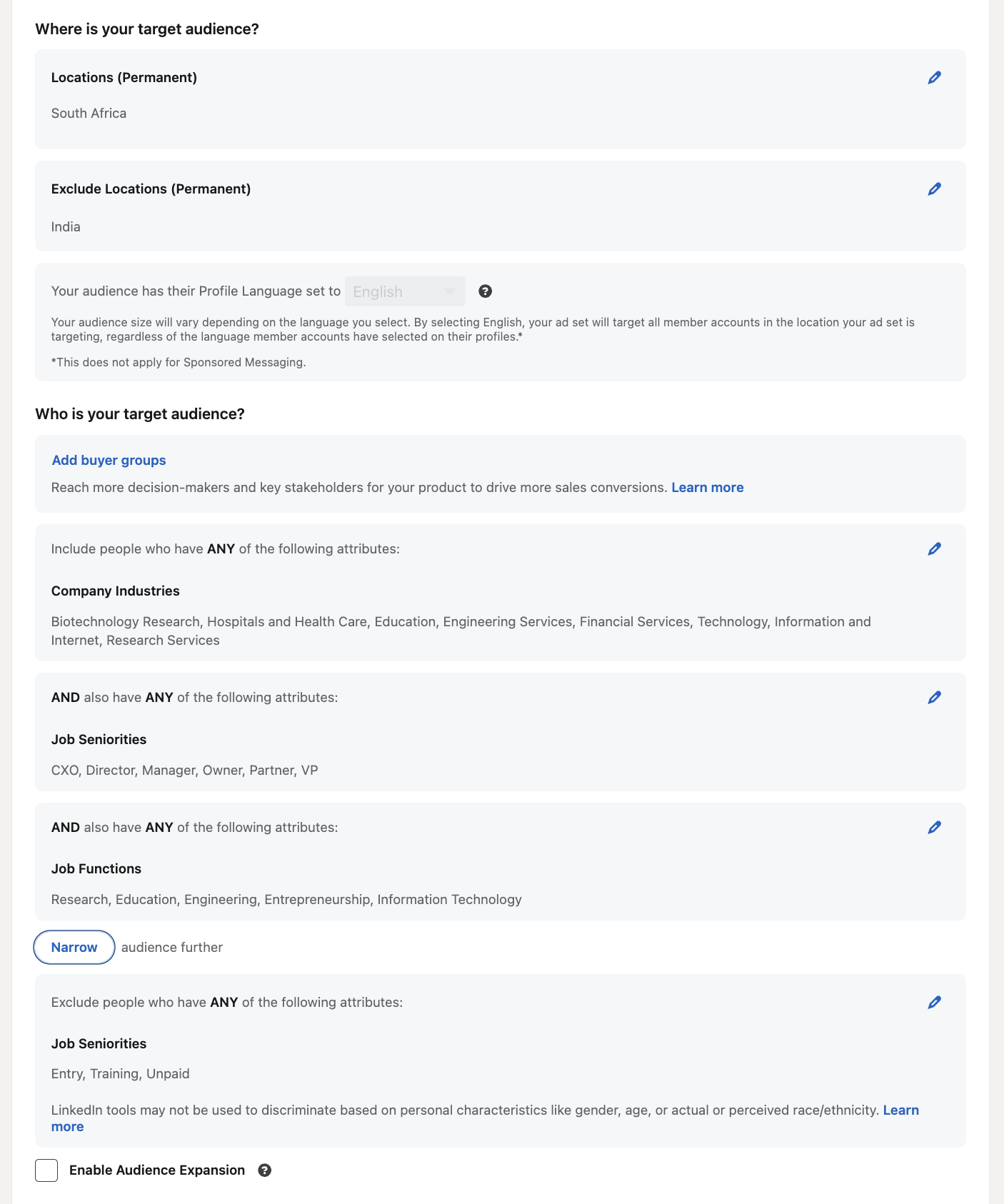
A live talent-visa audience. Note what is switched off: Audience Expansion is LinkedIn adding people you did not ask for, which is the opposite of what this campaign is for.
What that lands on is an audience of roughly 50,000 to 150,000 people. There is no useful "percentage of the total" to put beside it, because the starting pool depends entirely on how many countries you include: the same filter set can begin at four million or at close to a billion. The number that matters is the one you finish with.
2. Write ads that talk the wrong people out of clicking
This is the part firms push back on. Ad copy that names the bar — a doctorate, a decade in the field, a record of published or cited work — reduces click volume, sometimes sharply. That is the intended effect. Every click you did not buy from someone who would not have qualified is media saved and a consultation slot preserved.
Vague, aspirational copy does the opposite. It maximises clicks by making the largest possible number of people believe the ad is about them, and it pushes the entire filtering burden onto the consultation.
3. Ask the qualifying questions before the booking, not after
LinkedIn's lead forms take custom questions. The two or three that actually predict qualification for a given petition type belong there, where they are answered before the enquiry reaches anyone, rather than in an intake call after the enquiry already exists.
4. Report cost per qualified consultation
Not cost per lead. The number a firm should be given each month is what it cost to put one genuinely qualified person in front of an attorney, and alongside it, the loaded cost per signed case with attorney hours included.
Both numbers will be larger than the cost per lead the firm is used to seeing. That is the point: they are the first numbers that have described the actual transaction.
This is the system we build and run for immigration practices — the audience definition, the creative, the qualification questions and the reporting, as one thing rather than four. If it sounds relevant to your case mix, that is what a discovery call is for.
What this does not solve
Your cost per lead will go up. Often substantially. LinkedIn CPMs are considerably higher than search, and we are deliberately suppressing clicks on top of that. If cost per lead is the number your firm is judged on internally, this approach will look like a failure for as long as that remains the number. Change the metric before you change the channel, or do not change either.
EB-5 is a weaker fit than EB-1A or O-1. Investor visas turn on capital, and capital is not a LinkedIn profile field. You can proxy it — seniority, company size, industry, geography, business ownership — but a proxy is what it is, and the filter point moves less far than it does for credential-based petitions. We take this work on, and we are straightforward with firms that the mechanism is doing less of the job here.
Family-based and humanitarian work gets nothing from this. There is no profile field that corresponds to eligibility. The argument in this post applies to petitions decided by what a candidate has achieved professionally, and to no others.
If your attorneys are not the constraint, the maths changes. A practice with spare consultation capacity and partners who would otherwise be idle is not paying the $2,250 in the example above in any meaningful sense. Filtering late is genuinely cheap for that firm, and broad search may be the right channel for it.
It does not capture demand that already exists. Someone searching "EB-1A attorney" this afternoon intending to retain someone this week is in the market now, and LinkedIn will not find them at that moment. Search does. These are complementary channels and we have never argued otherwise.
The short version
Cost per lead measures the cheapest input in the process and ignores the most expensive one. In a practice where partner hours are the constraint, most of the real cost of a case acquired through broad search is consultation time spent on people who could never have qualified, and none of it appears in the report.
The fix is not a lower cost per click. It is moving the filter point earlier — into the audience definition, where an unqualified person is never shown the ad at all. That makes media look more expensive and makes the practice cheaper to run.
If you want one number to take to a partner: ask what proportion of last quarter's consultations were with people who were plausibly qualified. Most firms have never counted, and the answer is usually the whole argument.